Canalblog Tous les blogs
Suivre ce blog Administration + Créer mon blog
MENU

bobblez

Publicité
bobblez
Publicité
Archives
Publicité
24 avril 2008

child prostitution

Kanagawa high school teacher arrested for child prostitution

YOKOHAMA -- A teacher who performed indecent acts with a high school girl he met through an online dating site has been arrested police said.

The educator, Masaki Hayashi, 57, a teacher at Nihon University Buzan Girls High School, was arrested on suspicion of violating a law regulating matchmaking sites and the law banning child prostitution.

Investigators said Hayashi performed indecent acts with the 17-year-old girl at a karaoke parlor in Tokyo's Shibuya-ku at about 5:10 p.m. on Nov. 6 last year, when the girl was a first-year high school student. He has reportedly admitted to the allegations against him.

Hayashi reportedly wrote a message on a dating site saying, "I'm looking for girls who haven't tried compensated dating yet or are just beginners. I'm a prep school teacher and I'm good at teaching junior high school and high school students," using the message to lure the minor.

Publicité
4 avril 2008

school games

School yearbook ranks students likely to set fire to PM's residence

A section of the rankings included in the yearbook.

A section of the rankings included in the yearbook.

KAI, Yamanashi -- A junior high school here has come under fire over a yearbook that includes a ranking of students most likely to set fire to the prime minister's official residence.

The ranking was thought up by students editing the collection, under the guidance of a teacher.

"It was intended as a joke, but it was inconsiderate," a school representative was quoted as saying. The school apologized to students whose names were listed, but did not withdraw the book.

School officials say that the B5-sized yearbook, which includes the students' thoughts on their three years at the school and news during that period, is 150 pages long, and that it was distributed to 126 graduating students on March 10.

Four classes at the school decided to make a list of rankings, but those of one class included, "Person most likely to be living under a bridge," and "Person who looks like they have bad taste," with three students named in each category.

The school has always included rankings in its yearbook, but there hadn't reportedly been any inappropriate expressions used in the past.

School officials said that the offending page was removed from the book of one student, who complained that it was inappropriate.

"We're sorry that we hurt the feelings of a student," a school official was quoted as saying.

4 avril 2008

vers un remplacement de la langue officielle

Primary schools to teach 285 English words in '11

Fifth- and sixth-year primary school students will learn a total of 285 English words and 50 expressions in compulsory English classes to be introduced in the 2011 school year, the Education, Science and Technology Ministry said Thursday.

The students are expected to learn the words and expressions with textbooks compiled by the ministry titled "Eigo Noto," (English Notes), according to ministry officials. The 50 expressions are currently taught in the first year of middle school. The ministry has distributed a preliminary version of the textbooks--one each for fifth-graders and sixth-graders--to about 550 schools nationwide to be used on a trial basis in the school year that started this month.

The textbooks are designed to enable students to play games and introduce themselves in English by the time they graduate from primary school.

The students, however, will not be taught English grammar or spelling, they added.

To help teachers who have no experience in teaching English, the ministry has also made available CDs to be used for listening comprehension along with guidance for teachers that includes key points in helping students give speeches in English.

During the school year, both fifth- and sixth-grade students will receive a total of 35 English lessons, lasting 45 minutes each, according to the officials.

The English classes will focus on speaking and listening, but not on reading and writing, they said.

The textbooks are designed to teach English to primary school children through various activities, such as listening to content on CDs and "making presentations in front of classmates."

In Lesson 1 of the fifth-grader's textbook, students will learn how to say "hello" in nine different languages, including English, Chinese, French and Russian. Students will become familiar with greetings in different languages, not only through the textbook, but also the CDs, the officials said.

In subsequent chapters, fifth graders will also learn interrogative and negative constructions through bingo and other games, according to the officials.

Sixth-grade students are expected to learn more advanced English expressions. After getting familiar with the alphabet in Lesson 1 in the textbook written for their grade, children will practice giving directions with their classmates and produce their own English-language plays in groups.

In Lesson 9--the last chapter in the textbook--sixth graders will learn how to speak about their dreams in English, using expressions such as "I want to be a teacher."

Teaching guidance for primary school teachers presents detailed time schedules for each 45-minute class, allocating, for example, five minutes for "greetings at the beginning of the class" and 15 minutes for a "review of the previous lesson," according to the officials.

The guidance for teachers also gives details on key instruction points and teaching methods, such as "asking children questions while also showing them cards" offering contextual help.

Officials said it would be up to individual schools whether they use the teaching materials. However, the ministry plans to distribute them to all primary schools across the country so that they would be able to start preparations for the introduction of compulsory English classes in fiscal 2011, they added.

(Apr. 4, 2008)

26 mars 2008

laxisme reeduque

High school textbooks to get more difficult from 2009

Many of the nation's high school textbooks will get more difficult in the 2009 academic year, in line with the planned scrapping of the cram-free education policy, according to the results of textbook screening released Tuesday.

The latest screening was effectively the last under the current teaching guidelines, which stipulate the cram-free education policy, under which curriculum content for primary and middle schools was cut by 30 percent. That policy is now seen to have failed to achieve its intended results, and the Education, Science and Technology Ministry plans to revise teaching guidelines for public schools to increase class hours in the 2009 academic year.

Levels of difficulty also will be increased in many textbooks for key subjects such as mathematics, Japanese and English.

The latest screening also threw up many detailed objections to expressions or descriptions used in the textbooks. In one case, a poster drawn by Japanese artist Tadanori Yokoo was replaced due to complaints that it was inconsistent with the healthy development of children.

Included in a textbook for Art III, published by Nihon Bunkyo Shuppan Co., and titled "A La Maison De M. Civecawa," the poster was accompanied by text that read, "My daughter on sale at an exhibition." The artist was apparently equating his love for his daughter with the passion he puts into his work.

Such moves likely will prompt questions about the appropriateness of the textbook screening system.

For the screening, 48 textbooks for seven subjects--Japanese, English, mathematics, science, art, technical education and commercial education--were submitted to the ministry by private textbook publishers. Most of them are for third-year high school students for use from the 2009 academic year, which begins in April next year.

The ministry approved 47 of the books, rejecting one for Biology II submitted by Tokyo Shoseki Co., which it said contained numerous errors.

While references to the mass suicides during the 1945 Battle of Okinawa have previously been the subject of discussion in the screening of high school social science textbooks, textbooks mentioning the subject were not among those screened this year.

While textbooks for primary school students also were due to be screened, none were submitted as new teaching guidelines are to be implemented from the 2011 academic year.

Meanwhile, the level of difficulty was increased in many textbooks due to requests from teachers, who have pointed out that while curriculum content was reduced under the cram-free education policy, university entrance examinations were not made any easier.

Among 11 textbooks for Mathematics III, seven dramatically increased content, including material not required under current guidelines.

As for textbooks for English reading, Sanseido Publishing Co. increased the number of new English words by 20 percent to 1,155 in its new textbook, while the number of pages increased by 3.8 percent on average among the 15 newly approved English textbooks.

Meanwhile, problems were found with elements publishers had never expected to pose difficulty, such as the Tadanori poster.

Ministry screeners also voiced concerns over a photographic portrait of a photographer holding a cigarette in a textbook for Art III published by Mitsumura Tosho Publishing Co. As a result, the image of the portrait was modified by deleting the cigarette.

(Mar. 26, 2008)

17 février 2008

kanagawa board of education

Kanagawa plans compulsory Japanese history

The Kanagawa Prefectural Board of Education has announced plans to make Japanese history mandatory at its 152 prefecture-run high schools as early as the academic year beginning 2012.

Prefectures across the country reportedly have been considering making Japanese history compulsory at high schools, but Kanagawa Prefecture will be the first to do so. Japanese history is currently an elective subject, in line with the government's teaching guidelines.

The guidelines stipulate that high school students are required to study world history in a geography-history category, with students allowed to choose between Japanese history or geography.

Under a report on new teaching guidelines released in January by the Central Council for Education, an advisory panel to the education minister, world history would be the only compulsory subject.

The Kanagawa education board said it would keep world history compulsory and create two new subjects--"local history" and "modern Japanese and world history"--that meet the Japanese history requirements.

Under the plan, high school students would have the choice of studying both Japanese and world history, or studying world history, geography and the two new subjects.

The education board said it would implement the plan to coincide with the introduction of the new teaching guidelines for high school students to be issued during the next school year.

Starting in April, the education board will discuss how to make its own textbooks for the new subjects as they do not fall under the government's teaching guidelines.

Students who choose local history and modern Japanese and world history will be required to take one or two credits in each subject. To earn a credit, students have to complete 35 50-minute classes over the course of the year. It was decided to set the minimum requirement at one or two credits so as not to overburden students also studying world history and geography. The education board plans to pilot the two new subjects at some schools in the 2010 school year.

In Kanagawa Prefecture, about 30 percent of students from prefectural-run high schools graduate each year without learning Japanese history.

With such low rates of study, the prefectural education board, along with those in Tokyo, Chiba and Saitama prefectures, in September 2006 urged the Education, Science and Technology Ministry to make Japanese history mandatory. "In this age of rapid globalization, it's essential that students take subjects that deepen their understanding of their own country's history and culture," an official at the Kanagawa Prefectural Board of Education said.

The ministry made world history compulsory in teaching guidelines issued for the 1994 school year, saying world history had not been taught adequately at middle schools.

Takaichi Hikichi, head of the education board, said at a press conference: "Some young people don't even know there was a war between Japan and the United States. I want high school students who are open-minded, and who can contemplate these issues, to take another look at the nation's history and culture."

(Feb. 16, 2008)

Publicité
17 février 2008

inoccupied children tend to make problems ?

Government eyes increase in class hours / General studies class would be cut under plan

The education ministry on Friday unveiled a draft of new teaching guidelines for primary and middle schools that would increase classroom hours for arithmetic and mathematics as well as science subjects by around 15 percent during the nine-year study period, in a departure from the current guidelines, which emphasize "education with latitude."

The new guidelines, which were designed to respond to the criticism that children's scholastic abilities have declined due to the education-with-latitude policy, are scheduled to be implemented from fiscal 2011 at primary schools and fiscal 2012 at middle schools, according to the Education, Science and Technology Ministry.

However, the ministry will invite members of the public to submit opinions on the draft before officially announcing the introduction of the new guidelines in late March, ministry officials said.

It is the first time in 10 years that the guidelines have been totally revised, and the increase in classroom hours would be the first since the ministry started to cut classroom hours in 1977.

Class hours allotted for arithmetic, mathematics and some science subjects will be increased from fiscal 2009, in advance of the implementation of the rest of the guidelines.

Some content cut in the current teaching guidelines will be revived.

The so-called general studies classes, symbolizing the education-with-latitude policy, will be cut in both primary and middle school, to two classes a week from the current three at the primary school level, for instance.

The guidelines for kindergartens, to be revised concurrently, will be fully implemented from fiscal 2009, while a draft on teaching guidelines for high schools will be announced around autumn, according to the officials.

The draft was formulated along with a report issued in January by the Central Education Council, an advisory body to the education minister.

As in the current guidelines, the new guidelines' basic philosophy is "to foster the power to live." To improve the ability to think, judge and express oneself, the new guidelines attach importance to activities such as observation, conducting experiments and writing reports.

At the same time, the ministry says the guidelines are minimum requirements, enabling schools to teach advanced content at their own discretion.

Under the draft guidelines, the number of 45-minute classes will be increased by two a week for first- and second-year primary school students and by one a week for third- to sixth-year students at primary school. This means that the number of classes during the six primary school years will rise by 278 to 5,645.

Meanwhile, the number of 50-minute classes for first- to third-grade middle school students will be increased by one a week, meaning that they will have 3,045 classes, up 105, during the three middle school years.

The number of classes will be increased by more than 10 percent for major subjects at primary and middle school, including Japanese, arithmetic (or mathematics at middle school), science and social studies.

Under the draft, hours allotted for arithmetic and science at primary school will return to almost the same level before the education-with-latitude policy was implemented.

At middle school, the number of mathematics and foreign-language lessons will return to a level similar to that set in the previous guidelines. The number of science classes will rise by 33 percent from the current level.

The draft stipulates that fifth- and sixth-year primary school students be taught English once a week as a compulsory subject.

Concerning the content of some subjects that was cut under the current teaching guidelines, the formula for calculating the area of a trapezoid and studies of the Jomon period (ca 10,000 B.C.-ca 300 B.C.) will be reinstated in primary school arithmetic and Japanese history classes, respectively. At middle school, the quadratic formula will be back in mathematics textbooks.

A plan to make moral education a subject for grading under the teaching guidelines was shelved this time.

Under the banner of education with latitude, the current teaching guidelines, which were implemented in fiscal 2002, placed more importance on fostering students' ability to think for themselves by slashing learning content by about 30 percent.

However, the guidelines drew criticism for causing students' overall academic ability to decline.

(Feb. 16, 2008)

16 février 2008

NOVA - the take over

Ex-NOVA teachers file complaint about getting laid off by new owners

OSAKA -- About 20 foreign language teachers formerly employed by NOVA Corp. filed a complaint with a labor standards inspection office here on Friday, claiming that they were illegally fired by the companies that took over the failed language school chain.

"Unfair dismissal!" chanted the former NOVA teachers as they joined a prep rally held by the General Union in front of the Osaka Chuo Labor Standards Inspection Office in Osaka's Chuo-ku on Friday before they filed the complaint with the office.

Nagoya-based G.communication Group bought out NOVA after it filed for protection from creditors in October last year, leaving NOVA under bankruptcy proceedings.

However, G.communication Group fired about 800 former NOVA teachers at the end of December, overturning an earlier agreement in November that the company would in principle hire all the former NOVA teachers who wanted to work for the new employer, according to the General Union.

Furthermore, the company refused to renew employment contracts for about 200 other teachers, leaving more than 1,000 teachers unemployed. The dismissed teachers claim that the company violated the Labor Standards Law.

"The company violated the law in that it did not sign employment contracts with the teachers when they started working in November. The company's dismissal procedures also breach the law in that it notified the teachers of their dismissal via e-mail and without notice," said a representative of the General Union.

However, G.communication Group says they had good reasons to fire them.

"In the first place, we did not promise to hire all the teachers, but only as many as possible. We have reasons for the dismissal as some teachers refused to be transferred to other locations (in Japan)," said a representative of the company.

(Mainichi Japan) February 15, 2008

14 février 2008

mainichi shimbun

i have been wondering about this, there are more US troops in Japan than french people and families.

nowadays there have been a new case of rape of a 14 yod but a US soldier.

there have been a girl too cycling around okinawa by the base, and a soldier began pretending to shoot at her to scare her off. it worked.

Record of postwar fatalities and sex crimes caused by US military in Okinawa

Here is a short timeline of fatal crimes, incidents and sex attacks that members of the United States military forces have committed in Okinawa since the end of World War II in 1945.

* September 1955: An American military member rapes and kills a 6-year-old girl in Kadena.

* June 1959: A U.S. fighter jet crashes into Miyamori Elementary School in Ishikawa, killing 17, including 11 children.

* June 1965: A trailer falls from a U.S. military plane during training in Yomitan, landing on a girl and killing her.

* July 1966: An American serviceman kills a woman in Kin.

* May 1968: An American serviceman rapes and kills a woman on the side of the road in Yomitan.

* February 1969: An American serviceman kills a woman in Koza.

* December 1970: A U.S. military member's car crash sparks rioting in Koza with citizens torching over 70 U.S. military vehicles.

* April 1972: An American serviceman kills a woman in Kitanakagusuku.

* August 1972: An American military member kills a woman in Ginowan.

* December 1972: An American serviceman kills a woman in Koza.

* March 1973: An American serviceman kills a female restaurant worker in Koza.

* April 1973: An American service member is involved in a fatal tank accident in Kin.

* October 1974: An American military member kills a woman in Nago.

* May 1995: An American serviceman kills a woman in Ginowan.

* September 1995: Three U.S. military members abduct an elementary schoolgirl in the northern part of the prefecture, keeping her captive in their car before gang raping her. The crime sparks tremendous anti-base sentiment within the prefecture and anti-base rallies are held throughout Okinawa in October.

* October 1998: A U.S. Marine kills a schoolgirl in a hit-and-run in Kitanakagusuku.

* July 2000: A U.S. Marine breaks into an Okinawa apartment, performing indecent acts on the junior high schoolgirl sleeping inside.

* June 2001: A U.S. military member rapes a woman in her 20s in Chatan.

* May 2003: A U.S. Marine rapes a 19-year-old teenager in Kin.

* July 2005: An American serviceman indecently assaults an elementary schoolgirl in Okinawa.

* February 2008: A U.S. Marine is arrested for raping a junior high schoolgirl in Okinawa.

(Mainichi Japan) February 13, 2008

14 janvier 2008

voeux de M. Fukuda pour l'annee 2008

Fukuda Cabinet E-mail Magazine No.13 (January 10, 2008)
==============================

==============================

====

"Happy New Year. Let's make this a good year. This is Yasuo Fukuda."
-- Message from the Prime Minister (Provisional Translation)

Happy New Year. Let's make this a good year. This is Yasuo Fukuda.

How did you spend the New Year holiday? Besides attending
Their Majesties' New Year Reception at the Imperial Palace,
I enjoyed three quiet days with my family and relatives.

Japan will host the G8 Summit this year. On January 4, my first day
back at work, I unveiled the Summit logo mark.

The overarching theme of this year's Summit is that of global
environmental issues, such as global warming. The design that was
chosen for the logo mark is a motif of fresh sprouting leaves,
a collaborative work created by five high school students
from the Mie Prefectural Hokusei Kirara Gakuen School for Children
with Special Needs.

The logo expresses its creators' wish for "the Earth to forever
remain a beautiful planet covered in lush greenery." Rising above
the barrier of language, this motif is a powerful message
to the entire world.

Japan is a nation with an abundance of beautiful nature and
we boast the world's most advanced technology in the environmental
and energy conservation fields. I look forward to making this
Summit one that builds on these special strengths and I am sure
that we can succeed, with the cooperation of many people, in doing
so.

After unveiling the logo mark, I went to Ise Shrine. There, a local
reporter asked me if the fact that regulations governing food
labeling have been established by several ministries -- including
the Ministry of Agriculture, Forestry and Fisheries, the Ministry
of Health, Labour and Welfare, and the Ministry of Economy, Trade
and Industry -- has made it difficult for the people to understand
the issue.

Indeed, some parts of the administration are structured in a way
that, from the viewpoint of the people, may seem difficult
to understand.

As there are many different organizations in charge of similar
matters, you may easily get confused at which division to make
your inquiry. There may also be cases in which officials neglect
to specify the agencies to which inquiries should be redirected.
Given this situation, we have to acknowledge that the structure
of the administration has not been designed with the people in mind.

The pension issue, for example, has arisen as a result of various
problems that have piled up over a period of 40 years, including
the careless management of pension records, those being the vitally
important information about payments made by the people.
These problems occurred precisely because the administration
did not take into account the perspective of the people.

As Japan truly becomes an aging society, we must build toward
a safe and secure society. In order to do so, those in politics
and the administration must change their mindsets and
the conventional ways that things have been carried out,
and instead stand in the shoes of the people and the consumers.

My wish is to make 2008 the starting year of Japan's shift toward
becoming "a society in which the people and the consumers play
leading roles."

This year, I intend to tackle head on the major issues directly
affecting the people's lives, including the issue of incorrect food
labeling as well as pensions and other social security issues,
and steadfastly resolve them, one by one.

* Profile of the Prime Minister
http://www.kantei.go.jp/foreign/hukudaprofile/index_e.html

4 novembre 2007

NOVA - the quiet scandal

in Japan, everybody knows Nova.... from commercial to the power it oustanded. branches of Nava were in concurrence, tough job. tough limitations. tough economical surroundings.

Now NOVA is finished, bankrupt.

in the MAINICHI, the boss is said to have broken the labour laws, and is questionned about it nowadays. in the ASAHI ( you can see the article at the end of the text picture+text ) it is all question of bankruptcy...

i have been in message groups owned by NOVA teachers, the teachers and staff did not receive their salary. imaqgine your company stopping to give you your fai amount of money ? what can you do ?

other schools will beneficiate of this like BERLITZ, AEON, ECC, GEOS, so it is no worry, but the teachers .... the staff ........ what will they do ?

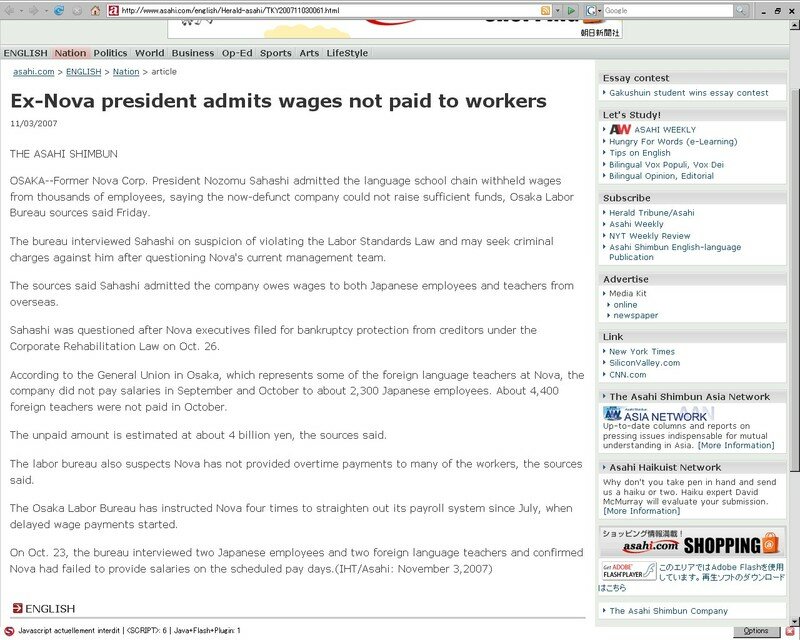
here is the article of ASAHI followed by the article of the MAINICHI, you make your point, you tell me.

Ex-Nova president admits wages not paid to workers

11/03/2007

THE ASAHI SHIMBUN

OSAKA--Former Nova Corp. President Nozomu Sahashi admitted the language school chain withheld wages from thousands of employees, saying the now-defunct company could not raise sufficient funds, Osaka Labor Bureau sources said Friday.

The bureau interviewed Sahashi on suspicion of violating the Labor Standards Law and may seek criminal charges against him after questioning Nova's current management team.

The sources said Sahashi admitted the company owes wages to both Japanese employees and teachers from overseas.

Sahashi was questioned after Nova executives filed for bankruptcy protection from creditors under the Corporate Rehabilitation Law on Oct. 26.

According to the General Union in Osaka, which represents some of the foreign language teachers at Nova, the company did not pay salaries in September and October to about 2,300 Japanese employees. About 4,400 foreign teachers were not paid in October.

The unpaid amount is estimated at about 4 billion yen, the sources said.

The labor bureau also suspects Nova has not provided overtime payments to many of the workers, the sources said.

The Osaka Labor Bureau has instructed Nova four times to straighten out its payroll system since July, when delayed wage payments started.

On Oct. 23, the bureau interviewed two Japanese employees and two foreign language teachers and confirmed Nova had failed to provide salaries on the scheduled pay days.(IHT/Asahi: November 3,2007)

Ex-NOVA boss questioned for breaking Labor Standards Law

OSAKA -- Nozomu Sahashi, the founder of the failed NOVA Corp., has been questioned for breaking the Labor Standards Law by failing to pay his employees, government sources said.

Officials of the Osaka Labor Bureau of the Health, Labor and Welfare Ministry questioned Sahashi, 56, last Monday. They are considering whether to file a criminal complaint with law enforcers, accusing him of violating the Labor Standards Law.

During questioning, Sahashi admitted that the company failed to pay wages to employees. "We tried to raise the money to pay wages by all means, but we couldn't," he was quoted as telling bureau officials.

NOVA's financial situation took a dive after the Economy, Trade and Industry Ministry imposed a six-month ban from making long-term contracts with students in June for its unfair business practices.

It has not paid salaries for September and October to Japanese employees and wages for October to instructors. The unpaid wages amount to about 4 billion yen.

novaarticle

Publicité
1 2 > >>